Showing posts with label Durban. Show all posts

Wednesday, December 7, 2011

No to backtracking and delaying!


The letter below expresses the anger and unhappiness of many Africans at talk of a 'new mandate' at COP17. It is currently being circulated for signature by organisations, and will be handed over tomorrow. (Signatures - of organisations but not of individuals - can be added by emailing greeder@coa.edu.)

No Durban mandate for the great escape

As African civil society, social movements and international allies, we reject the call of many developed countries for a so-called “Durban mandate” to launch new negotiations for a future climate framework.

A new mandate for a new treaty in place of the Kyoto Protocol should be understood for what it really is – rich countries backtracking and reneging on “inconvenient” obligations, at the expense of the poor and the planet. While developed countries may appear progressive by asking for a mandate to negotiate a new legally binding treaty, the truth is that this is nothing but a veiled attempt to kill the Kyoto Protocol and escape from their further mitigation obligations under the already existing mandate in the Protocol itself, and the agreement in 2005 for negotiating further emission cuts. A political declaration to continue the KP is, in practice, another nail in its coffin. Anything less than a formal legal amendment and ratification process, will deliver an empty shell of the Kyoto Protocol.

Agreeing to a new mandate would mean action is effectively delayed for five to ten years. A new treaty will take several years to negotiate with several more years needed for ratification. Further, there is no assurance that countries that have repudiated the existing legal architecture, like the United States, will agree to or ratify a new agreement, nor that such agreement will not be a weak and ineffective “pledge and review” system.

Developed countries must urgently scale up the ambition of their emission reduction targets. As the latest reports by the International Energy Agency make clear, deep emission cuts are needed now to have a realistic chance of limiting temperature rise to 1.5°C. Current emission reduction pledges will lead us to a world that is 5°C warmer. For Africa, this means 7 or 8°C of warming and unimaginable human suffering. This is why a pledge-based approach with weak review rules, instead of the Kyoto Protocol’s approach of legally binding commitments and international rules that give meaning to these commitments, is completely insufficient to ensure the necessary emission cuts.

While many developed countries condition any further action, including fulfilling their legally binding obligations to a second commitment period of the Kyoto Protocol, on greater action by emerging economies, developing country pledges already far outweigh pledges by developed countries. In fact, with accounting loopholes and the use of carbon markets, developed countries could make no net contribution to reducing emissions by 2020.

While many developed countries seek to end the Kyoto Protocol, they simultaneously attempt to retain and expand their favored elements of the Kyoto Protocol, like the CDM, in a new agreement and shift their responsibilities onto developing countries. Without legally binding emission reductions under the Kyoto Protocol, developed countries must not be allowed to have access to the carbon markets. Further, with the price of carbon crashing, paltry emissions reductions pledges from developed countries, there is no rationale for the continuation of the CDM or the creation of new market mechanisms.

Developed countries must scale up their ambition and stop blaming other countries who have contributed far less to the climate crisis, yet are taking on more aggressive action. Developing countries are living up to their promises made in Bali, while developed countries are attempting to re-write the rules of the game to avoid meeting their obligations.

Developed countries are also denying developing countries the necessary finances and technology to address the climate crisis. The provision of finance from developed to developing countries is an obligation in and of itself. It must not be used as a bargaining chip in the Durban negotiations, nor should it be dangled in front of poor countries as a bribe to get agreement for a very bad mitigation deal. The same applies to the operationalization of the Green Climate Fund. Success in Durban depends on the Green Climate Fund not being an empty, ineffective shell.

We will not accept a “Durban mandate” or any outcome that locks in the current low ambition and inaction for many years, and condemns billions of people in Africa and across the world to suffer the worst impacts of a warming world.

Signed by:

Africa Trade Network

Alternative Information Development Centre

Democratic Left Front

Friends of the Earth International

groundWork, Friends of the Earth, South Africa

Jubilee South (Asia Pacific)

Pan African Climate Justice Alliance

Rural Women’s Alliance

South Durban Community Environmental Alliance

Southern African Faith Communities' Environment Institute

Third World Network

Trust for Community Outreach and Education

Tuesday, December 6, 2011

Give the earth her due


Captions: Energy is the key to South African protests; the thick blue line;
Natlie greene's impassioned plea; the Engen oil refinery with houses in the background.


The sharp end of fossil fuel use is felt in the South Durban Basin, nicknamed ‘cancer valley’. This is not just one of the most polluted places in South Africa, it’s one of the worst in the world – and it’s just a twenty minute drive from where the so-called Conference of Polluters (COP17, the 17th Conference of the Parties) is taking place.

South Durban is where 80% of the imported crude oil in South Africa is refined, at Sapref (jointly owned by Shell and BP) and the Engen refinery which has had a number of fires, the latest in October 2011.

More than a quarter of a million people (mostly blue-collar) live all around these refineries and other polluting industries, including a paper mill – 150 smoke stack industries in all. About 15 years ago, locals started to campaign around the issue of the health impacts they were experiencing – more than half the children in local schools suffer from asthma, for example, while cancer is far too common. (Bobby Peek, one of the founding fathers of activism in this region, grew up playing rugby on a field close to the Engen refinery. Four of his team-mates have since died of cancer. If you live here, research has shown, you are 250 times more likely than residents elsewhere to get cancer.)

The South Durban Community Environmental Alliance (SDCEA) won some notable victories, pressurising the authorities to create a local system monitoring and regulating air quality – sadly, this year the staff complement was cut by half, so the activist now use the ‘Bucket Brigade’, a cost-effective system which enables them to sample the air themselves (it gets sent to California for independent testing – the results show massive readings of nasties like benzene, methanol, sulphides and jujst about every chemical you can think of, some of which can readily be smelt in the air). Today, under the guidance of another long-term local activist, Desmond D’Sa, a group of COP17 visitors took what the SDCEA calls ‘the Toxic Tour’ to see houses cheek-by-jowl with massive refineries and stacks belching smoke. We can smell rich whiffs of pungent stuff, and Desmond tells us it’s worse at night.

The tour was followed the whole way by police who, tellingly, conferred with members of the refineries’ security staff. We ended up at the front gate of the Engen refinery, where, it turned out, we had a welcoming committee. Dozens of police, many in full riot gear, were lined up at the gates.

A protest had been planned, and activists whipped out a slew of banners to line the road.

I stepped across the road to get a picture, but was ordered back:

“Get back!”

“But I’m a journalist, I just want to get a picture…”

“Get back, that was NOT in your permit!”

Turns out he took the blue cap I and many others were wearing, with the simple slogan, ‘Unite against climate change’, to mean I was a protestor too. Which made me one of those alien creatures the police have been warmed against. At Saturday’s march, a policeman told me, “These people can be dangerous, you know,” which did seem odd at a moment when a trio of dancing, half-naked women happened to be passing… Yesterday, the waste pickers were protesting – in accordance with their permit – outside the ICC, but when they held up banners and posters, they were apparently ordered to desist – the banners and posters were ‘not in your permit’. (Surely banners and protesters are as natural a combination as love and marriage, beans and samp or cops and guns?) Control of the aliens from NGOs and civil society – fatherly but firm – has been the name of the game.

The protest was used as an occasion to publicise, on a world stage, the campaign to recognise the Rights of Mother Earth. Last year, on Earth Day, a group of 35,000 people adopted a Universal Declaration on the Rights of Mother Earth in Cochabamba, Bolivia. This records that Mother Earth has:

The right to live and to exist;

The right to be respected;

The right to regenerate its bio-capacity and to continue it’s vital cycles and processes free of human alteration;

The right to maintain their identity and integrity as differentiated beings, self-regulated and interrelated;

The right to water as the source of life;

The right to clean air;

The right to comprehensive health;

The right to be free of contamination and pollution, free of toxic and radioactive waste;

The right to be free of alterations or modifications of it’s genetic structure in a manner that threatens it’s integrity or vital and healthy functioning;

The right to prompt and full restoration for violations to the rights acknowledged in this Declaration caused by human activities.

This legal route, says Cormac Cullinan, a South African lawyer who helped draft the Declaration, may be the best to take to protect the environment – give Earth legal rights which can contested and enforced through the courts.

This has already happened in Ecuador, the first country in the world to enshrine these natural rights in law, says Natalie Greene, another speaker at the protest. Greene is an environmental activist with Fundación Pachamama, a group which helped rewrite that country’s constitution in 2008. A recent case in Ecuador offers an example of how such ‘Wild Law’, as Cullinan calls it, could work: “the Provincial court of Loja granted an injunction against the Provincial Government of Loja to stop dumping excavation material into the Vilcabamba river, because it violated the constitutional rights of the river to exist and maintain its vital cycles, structure, functions, and evolutionary processes” (www.uncsd2012.org/rio20/).

By EarthSummit 2012/Rio+20 in June 2012, the aim is to present a petition containing one million signatures calling for the universal acceptance of the rights of nature. Go to www.rightsofmotherearth.com to find out how to add your name.

Friday, December 2, 2011

Down to zero


Captions: Marlen Charcon from Costa Rica with New England waste pickers; A truck-full of recyclables; Great slogans; l-r Manisha Desai, outreach manager at SWACH, India, with Mrs Sushila Sabale and Mrs Suman More;


Visit any dump site or landfill in the developing world and you will see people picking through the waste, alongside flocks of birds doing the same. Most of us who live comfortable suburban lives will shudder and turn away, either horrified at the desperation or repulsed by the idea of sorting through others’ grubby, messy leavings.

But we should not. We should applaud the waste pickers as strong and independent people who are making a living off our excessive trash – and as heroes in the struggle against climate change.

Waste pickers extend the life of landfill sites by reducing the amount of waste that needs to decompose; they reduce greenhouse gas emissions (GHG) from the landfill itself; they reduce GHG by making available materials that would otherwise have to be obtained from virgin sources (every ton of paper recycled means 17 trees left standing, for instance); using recycled materials is often less demanding on power than virgin materials, thus reducing GHG again; and on top of all that, the waste pickers are making a living, supporting their own families and even supporting other jobs (in the recycling industry) which would not exist but for their work.

Finally, consider this: “Recycling is one of the cheapest and fastest ways to reduce greenhouse gas emissions. Avoiding one ton of CO2 emissions through recycling costs 30% less than doing so through energy efficiency, and 90% less than wind poer.” (www.globalrec.org, the website of the Global Alliance of Waste Pickers)

Talking to a meeting of waste pickers at COP17, Neil Tangri of the Global Anti-Incinerator Alliance asked “How many times has it happened to you that a stranger comes up to you and says Thank you for what you are doing, thank you for fighting climate change?” The answer, from an audience composed of South African Waste Pickers Alliance members and several representatives of international organisations, was loud shouts of “No! Never!”

On Day 3 of COP17, leaders of waste picker-groups in most major cities of South Africa talked about the obstacles they face and the solutions they need, and listened as Indian and Costa Rican waste pickers offered encouragement and practical advice.

Given the huge contribution waste pickers are able to make to mitigating climate change, it’s astonishing how often the same problems are repeated, over and over again: harassment by police and municipal authorities, lack of recognition for their role and active disrespect, being blocked from landfill sites and more.

Perhaps local and regional governments should take a long hard look at the science available on options for managing waste. On the one hand, you have the classic landfill site, in which layers of shale and clay and high-density poly-ethylene are used to seal the ground beneath pits which will hold strata of waste. This will ultimately be sealed over, and, according to international standards of best practice, will be rehabilitated with vegetation, while the methane gas which forms in the decomposing mound will be siphoned off to create electricity or be used for cooking. Alternatively, waste can be incinerated, but this, of course, has environmental impacts and should, ideally, be a last resort (and incinerators used to generate electricity emit more CO2 than coal-fired power plants).

Waste pickers, on the other hand, are a very efficient method of reducing waste to – well, it sounds like wishful thinking to say to zero, but that’s the promise we were made by Mrs Suman More from Pune, the eighth largest metropolis in India (it’s in the same state as Mumbai). “We are confident that we can recycle ALL the waste which is generated – except waste which cannot be recycled at all,” she says firmly. She brings years of hands-on waste-picking and organising among waste pickers to bear when she speaks.

Human beings are by far the best ‘machine’ for doing this work, she said on a field trip to two local landfills. Our group was standing on a berm overlooking the New England Landfill outside Pietermaritzburg (the Msunduzi municipality), a small city close to Durban where COP17 is being held. We were watching a group of waste pickers pack a truck with a towering load of material they’d picked off the dump and were now taking to sell to companies which recycle paper, plastics and other materials.

Where the role of the waste picker is recognised by authorities, dry waste is reduced to a minimum in this way, while wet waste (organic and messy stuff like food) is separated before even reaching the landfill and used to make compost. (Since it decomposes rapidly and produces methane in the process, this can be used to generate electricity or cooking gas.)

Humans are highly efficient at picking out every last little bit of opportunity in the mounds of waste brought to landfill sites. Before we visited Pietermaritzburg, we’d explored the state-of-the-art Marianhill Landfill site just outside Durban. While the rest of us admired the beautiful and pioneering conservancy around the site, and the attractive green hill created by a rehabilitated landfill, Indian, Costa Rican and South African waste pickers were shocked to see all that recyclable waste being simply covered over!

The New England Landfill is a very different set-up. Of course it’s not a pretty sight, but dozens of people were still at work waste-picking in the late afternoon when we arrived, and they gathered around curiously. When they discovered that the international delegates did the same work, and had experiences to share, they were eager to hear more.

The Indian women, Sushila Sabale and More, talked about how they had fought for recognition 15 years. Now waste pickers have identity cards which entitle them to collect rubbish door to door, directly from householders (this makes separation less arduous), and they have their own shop selling recyclables, which has improved the prices they get for their materials.

“You must be organised,” Marlen Charcon from Costa Rica told the group. Having seen how it can help improve circumstances for waste pickers, she is passionate about uniting in organised groups, which can negotiate better prices with buyers and better conditions with waste site managers.

The manager at the New England site, Cyril Naidoo, listened with interest. He is a rare exception, a manager who, after 16 years on the job, appreciates the role the waste pickers play and sees them as human beings with a right to earn a living.

“It’s not good to work here – but we can support our families,” said Patricia Kheswa, a middle-aged woman waste picker at the New England site. There was general agreement that it’s not pleasant work, but it opens up opportunities. “Our children don’t work as waste pickers,” said More. Her children have all been able to study – one of them, she tells us, is a journalist. Her days of hard manual labour, which are reflected in her hands and face, have left a proud legacy.

Life should not – and does not – have to be so hard for waste pickers, in both the global north and south (wherever there is waste, there are waste pickers). If we all clearly understood the cost our throwaway society was extracting from the environment, we would be more respectful of their role, actual and potential, in mitigating that. And once we’ve recognised that, it’s surely does not take much to offer safer on-site conditions through simple equipment like heavy-duty gloves and boots, as well as some comfort in the form of, perhaps, ablution blocks and sheds for shelter? At the very least, we could refrain from harassing them and chasing them away from landfill sites. At best, as Naidoo hopes to do, landfill management could negotiate a safe and legal role for organised groups of waste pickers.

And at the level of COP17, waste pickers around the world would like official support for waste recycling (rather than the fashionable ‘waste-to-energy’ projects espoused by so many cities round the world). Carbon credits for incinerators and landfills just discourage recycling, they say. Waste pickers would like direct access to funding available through ‘Green Climate Funds’ to enhance their efficiency at recycling – and make the most of their ability to reduce GHG. Here’s hoping some of the bigwigs in COP17 are listening!

Monday, November 28, 2011

Dateline Durban


The heavens welcomed delegates to the 17th Conference of the Parties with a massive rainstorm on Sunday night which left streets awash with water (and killed eight people).

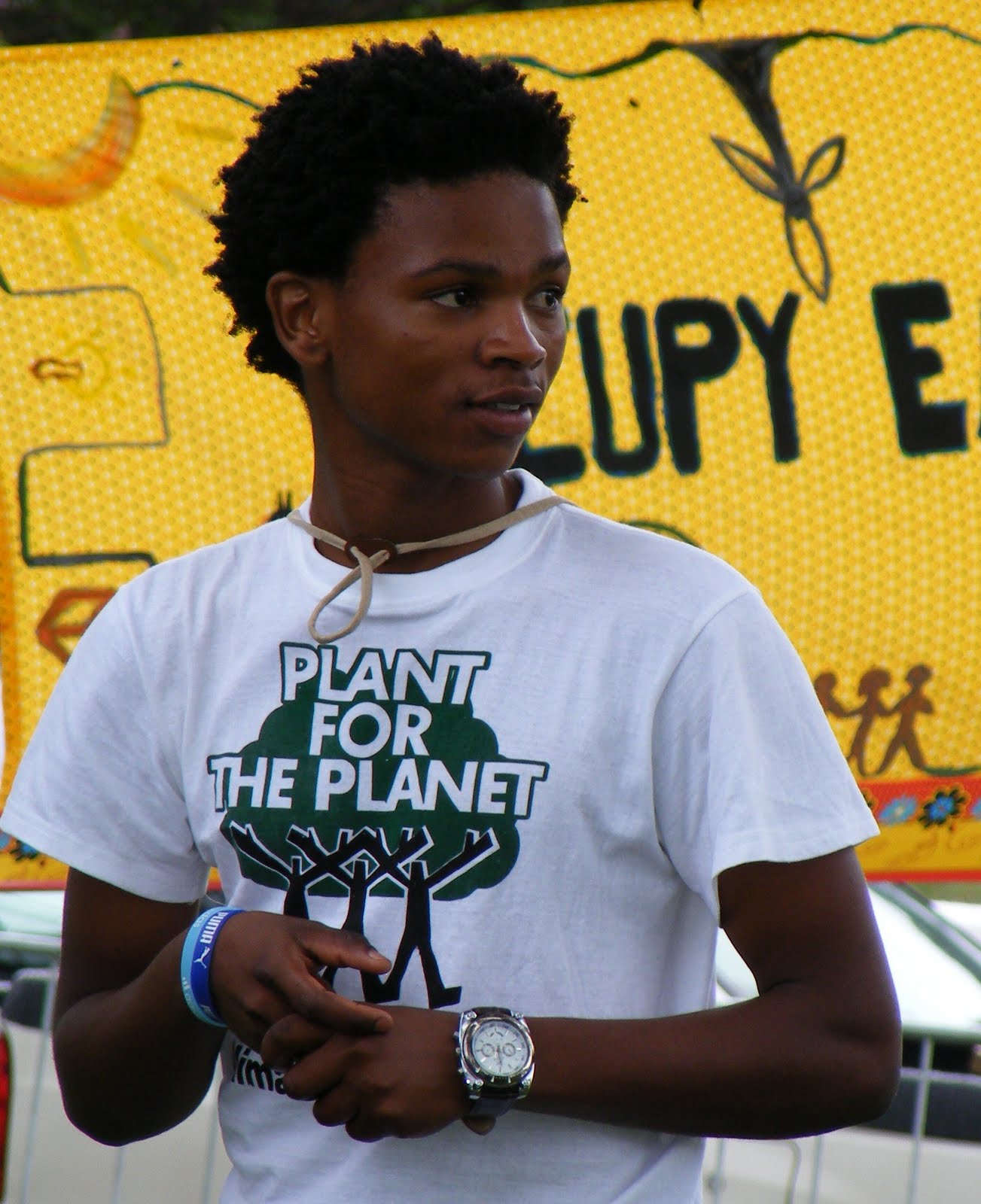
eThekwini Municipality had fielded a rather intimidating force of policemen and women, as well as a horde of young people clad in vibrant green T-shirts labelled COP17/CMP7, but none of them knew where Speaker’s Corner was. This little patch of greenery, opposite the International Convention Centre (ICC) where all the suits are engaged in meaningful mainstream activities, is the negotiated terrain where the city will allow a certain amount of protest activity. Just before midday today, it attracted a small crowd of about 50 activists, some from far afield (there were two Bolivians present, for instance) and some locals. One such was Fundile Dlamini (see right), from a local climate foundation (Plant for the Planet) aimed at creating awareness among children. “Children are the ones who’re gonna be holding on to the future, so they have know about this and they have to act to be helpful about this matter,” he told me.

More Occupy events are planned for the next several days.

This evening, Dr Michael Dorsey from Climate Justice Now! Network, the second largest ENGO coalition in the UNFCCC process, urged the parties to reach a legally binding agreement for substantial reductions in emissions.

He pointed out that carbon trading, Clean Development Mechanisms and similar strategies have failed: “Carbon prices are haemorrhaging. In the two-week lead up to the negotiations here in Durban carbon prices fell more than 30%!” He went on: “Just last week one of the top ten largest banks on the planet, the largest Swiss bank UBS, repeated what is becoming a common mantra: carbon prices are too low to even have an environmental impact.

“We urge you to a) shut down the Clean Development Mechanism and B) do not attempt to link any forms of climate finance to flexible mechanisms or market instruments.

“Devise justice based mechanisms not based in failed market efforts.”

Justice mechanisms might include legal rights for the planet, a cause espoused by Cormac Cullinan, environmental lawyer from South Africa who coined the term ‘wild law’. He is at COP17, and I’ll be talking to him during the course of this week.

(Find his ideas in his book Wild Law: A Manifesto for Earth Justice on Kalahari.com or Amazon.com.)