Showing posts with label COP17. Show all posts

Thursday, December 22, 2011

Not so civil, please!


When did we become such compliant people?
One of the most striking aspects of COP17 in Durban early this month was the relative tameness of the protests. Altjhough I was told by one policeman at the Global Day of Action that “these people can be dangerous, you know”, little sign of that was seen. And on the night of 9 December, when a number of people seemed keen to occupy the precinct to make their voices heard by the negotiators, the protest seems to have been rather peacefully organised and negotiated away.
Meanwhile, here in Johannesburg, citizens are enraged that we’ve had a road tolling system imposed on us without consultation, which will become active in February. This will significantly increase commuting costs. (Under other circumstances, I’d be in favour of something like this – it’s one of a number of tactics necessary to reduce the number of cars on the road and boost use of public transport. But because, a) public transport is poor, with trains and buses only on limited routes, and minibus taxis notoriously unsafe and driven by badly trained drivers and b) there’s been a huge lack of transparency in the process, it makes me as angry as the next resident.)
It’s a situation that screams for civil disobedience. If even ten percent of vehicles refuse to install the new ‘e-tag’ licence plates necessary for smooth processing, and then refuse to pay fines, the entire system would freeze within a month or two. Yet I have heard many people discussing this, on talk radio and in public spaces, wondering if it’s okay to do something illegal. Does civil disobedience not have to be “within the law”, I heard one person ask.
Good grief, and you live in South Africa, where we have a splendid record of civil disobedience! That’s what civil disobedience IS: a campaign in which numbers of people state that they will disobey laws or regulations with a certain end in mind – usually it’s getting those laws off the statute books. When people burnt their passes, it was an act of civil disobedience, and very much illegal, with the aim of getting the laws about the dompas wiped out.
The roots of a police state are not the apparatus thereof, it’s the willingness of the people to ‘go along’, to accept, to be policed. That, in my view, was the mindset shown on 9 December: security says we must get out of the building, so let’s negotiate the best way to do this. (To be fair, though, I wasn’t there, not being accredited to the UN precinct, so there may have been circumstances I’m not aware of.)
It’s not the negotiators who get us places, in my experience. They’re very useful once the wall has been partially smashed, once the square has been occupied… but action is necessary to shift the blockages. If we want to change the world, we need to grow some more spine!
“Civil disobedience is the active, professed refusal to obey certain laws, demands, and commands of a government, or of an occupying international power. Civil disobedience is commonly, though not always, defined as being nonviolent resistance. It is one form of civil resistance.” (Wikipedia)
“…the refusal to obey certain laws or governmental demands for the purpose of influencing legislation or government policy, characterized by the employment of such nonviolent techniques as boycotting, picketing, and nonpayment of taxes.” (dictoionary.com)

Saturday, December 17, 2011

Citizens get it - their governments don't


A recent survey by Yale University’s Project on Climate Change Communication and the George Mason University Center for Climate Change Communication found that 65 percent of Americans polled “said that global warming is affecting weather in the United States”; half believe it is caused “mostly by human activities,” up 3 points since May. A similar survey by the nonprofit environmental group ecoAmerica found that 57 percent of Americans realize, “If we don’t do something about climate change now, we can end up having our farmland turned to desert.” (From Salon.com, 16 Dec 2011)
According to the latest Eurobarometer opinion poll (October 2011), 68% of Europeans polled consider climate change a very serious problem (up from 64% in 2009). Altogether 89% see it as a serious problem (either 'very serious' or 'fairly serious'). On a scale of 1 (least) to 10 (most), the seriousness of climate change is ranked at 7.4, against 7.1 in 2009. (From Media Lens, 17 Dec 2011)

Friday, December 9, 2011

Whose process is this?

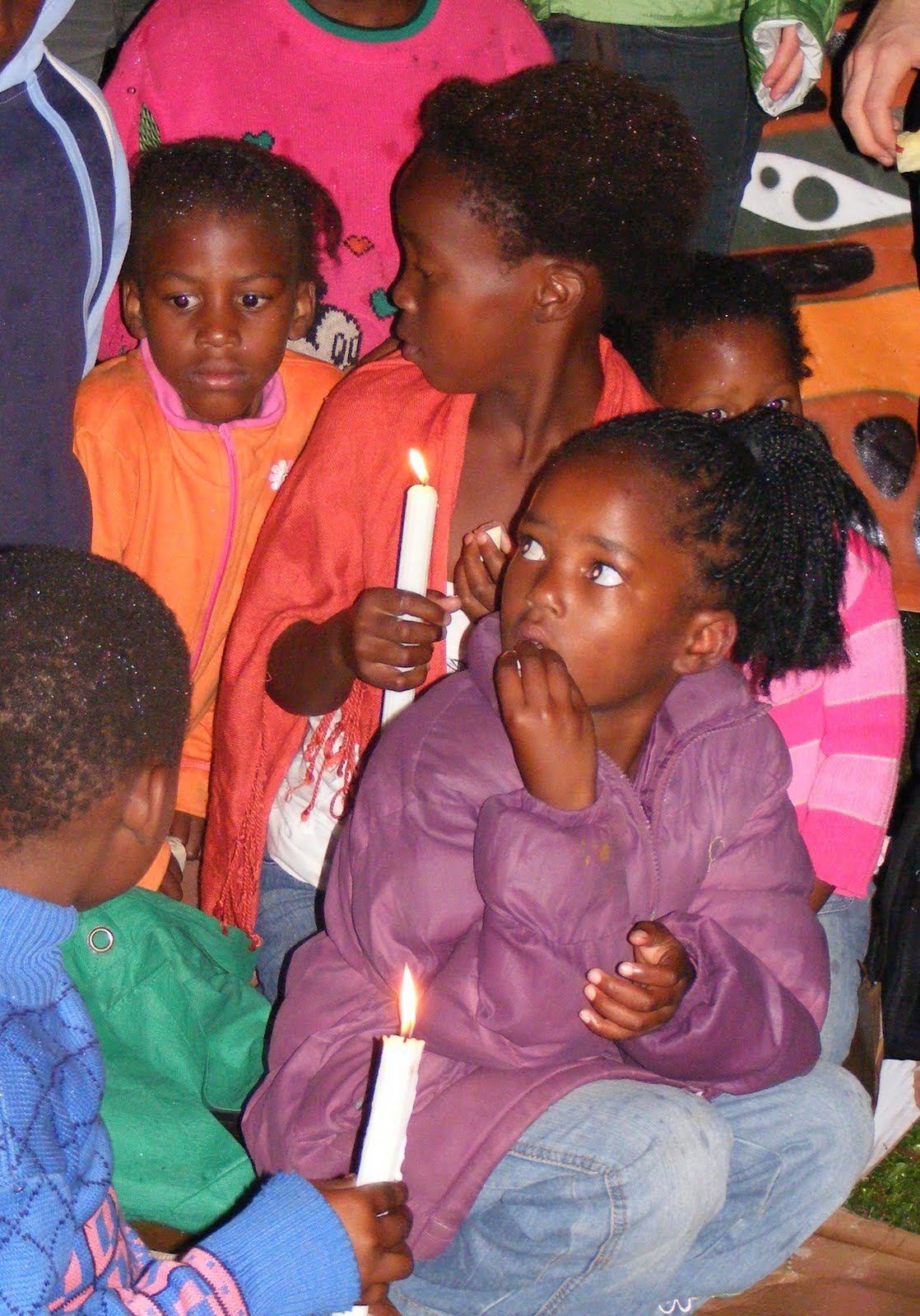
Captions: Bobby Peek of groundWork addresses the last remaining activists on 9 December; Africa will be hardest hit; some youngsters joined the all-night vigil, under tarpaulin due to the rain.


The Conference of the Parties is winding to a close. We've seen a document which suggests that the result will be the launching of "a process in order to develop a legal framework applicable to all" (this, of course, means developed and developing countries), a framework agreement committing countries to new targets to cut greenhouse gas emissions, "after 2020". Yippee. This puts us on course to (at least) hit a global increase of 4 degrees, which means 8 for us in southern Africa.
As one woman said at the traditional all-night vigil which started at 7:00 pm (she's been to three COPs and attended vigils at each one), "If this isn't working" - as plainly, after 17 years, it isn't - "then what do we do?"
I doffed my journalist's hat and made an activist's plea. Let's take it away from them, I said. Let's mobilise people to put pressure on them - the governments and corporates inside the UN precinct. They live, breathe and make money off us, so we do have power over them. Civil disobedience campaigns, boycotts, persistent picketting, we've used them before with success. "Never doubt that a small group of thoughtful, committed people can change the world. Indeed, it is the only thing that ever has." (Margaret Mead)
We just have to get the message through to people that this is not a political cause, this is about things that do and will matter to them where they live: food, water, air, health, life. Understand that, and massive mobilisation is possible. It's time to tell those who are delaying and backing and filling that we have withdrawn their permits, their rights to act against our common interests. Panzi! Vamos!
Siyaya!

Thursday, December 8, 2011

Green Bombers


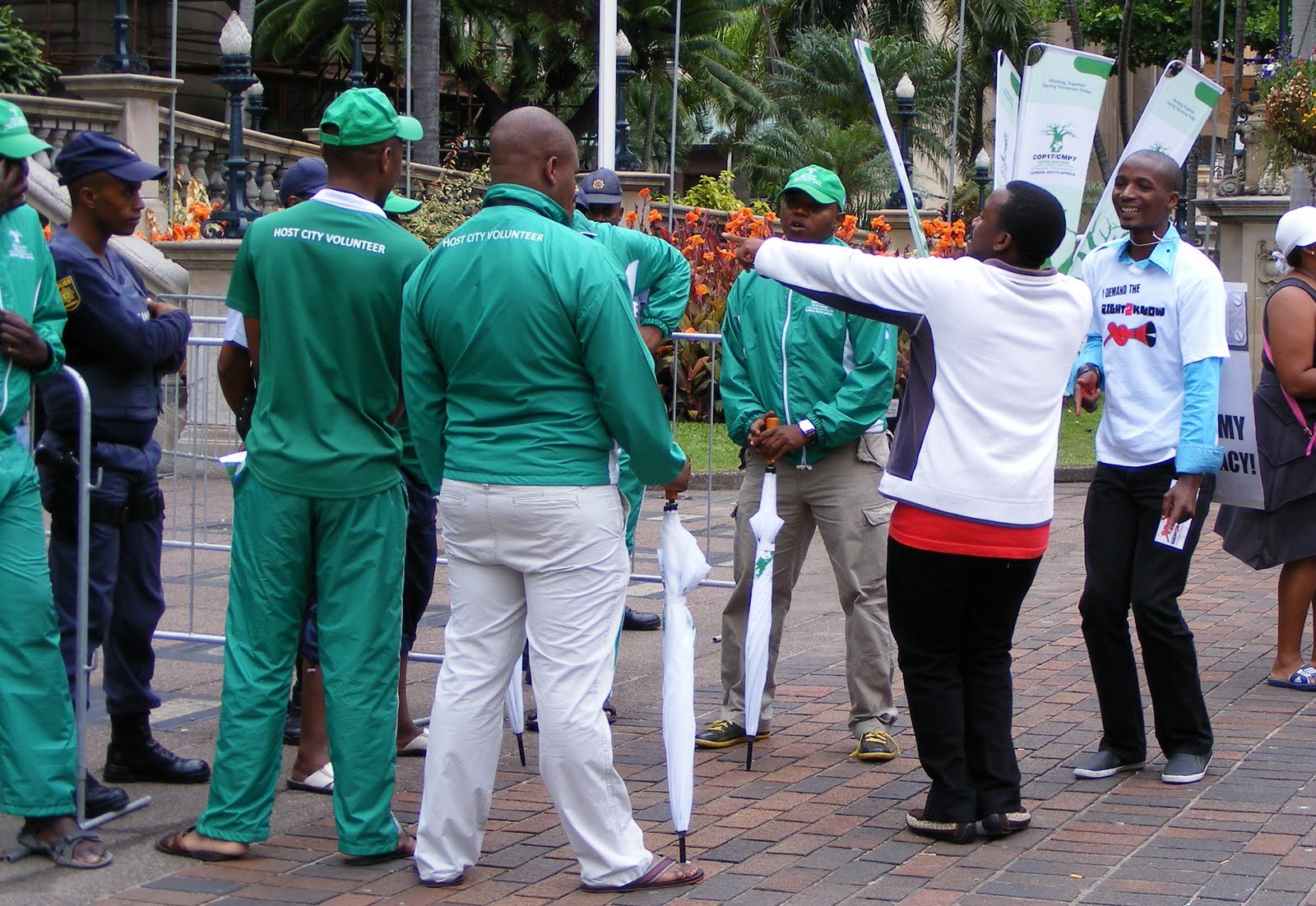
Ever since Saturday’s Global Day of Action at COP17, it’s been apparent that there are some people wearing the green uniforms of Host City Volunteers who are not quite the innocent volunteers they seem. Activists have taken to calling them the Green Bombers, and I had a taste of them today at Durban’s City Hall.
I’d joined a very small group of angry people who were staging a spur-of-the-moment protest outside City Hall, where President Jacob Zuma was addressing a meeting. There’d been talk that the Kyoto Protocol was dead, and the so-called Durban Mandate would take its place, which activists feel is a very unsatisfactory result. When we arrived, the two people carrying banners reading ‘Africa will burn’ and ‘Blood on your hands’ were immediately accosted by the Green Bombers and told “You can’t be here”. A journalist from Montreal came to their rescue, getting indignant about the infringement on people’s rights.
In addition to the small group I’d linked up with, there were a number of people from the South Durban Community Environmental Alliance, and the contingent of aggressive Green Bombers got to work, trying to clear them from the public space as well. (I asked one to tell me what regulations he was operating under. His response was, “Lady, I don’t know, I’m just following orders from security.” Cops in riot gear were spread out across the entrance to City Hall, and the police and Green Bombers communicated with each other frequently.
‘My’ banner holders painted their palms with red paint to symbolise the ‘blood on our hands’, and the fashion soon spread across the square. To our amazement, the Green Bombers refused to let anyone with painted hands into the City Hall to attend the meeting. It would, explained one man to me, “make people excitable” inside.
As I listened in on one woman argue with the Bombers, I heard him say that he was with intelligence. Naturally, I trotted over and asked him to repeat this and explain. He said, “Of what value would it be to you to know?”
“I think it would be of great interest to the citizens of South Africa to know that their intelligence officers were dressing up in UN Host City Volunteer outfits.”
At that, I was subjected to a tirade about “you journalists”; that wonderful pejorative, ‘opportunistic’ was used, as I began to walk away. I turned and charged back, asking the user to explain exactly what ‘opportunistic’ means. Apparently it means people like me, who listen for something they can use that’s sensational, “even a joke like this”, and then write “stories without content”.
“Why don’t you simply tell the media the truth?” I asked. “When I asked about the comment, why did you not just say it was a joke?”
“You, you represent a noble profession which has lost all its morals,” I was told, along with much more about how I write such stories simply to make lots of money and the like. All the time, the aggression was palpable and the sense that one wrong move would provoke some kind of threat, at the least.
Shortly after this, a very angry man burst out of City Hall, waving a small poster. He and the young woman who followed him out were enraged that they had been thrown out of the meeting for silently and peacefully holding up posters. They melded with the protesters outside, and some very loud and angry chants of Panzi followed (Panzi means ‘Down with’ and is always repeated, as in “Panzi Canada, panzi!”). We had Panzi Zuma, Panzi the USA and EU, Panzi COP17 – and, from the angry young woman, “Panzi people who dress up in uniforms and pretend to be volunteers, but are getting paid by who knows who, panzi!” (That’s a loose translation given to me by a fellow journalist.)
After two hours at the protest, I moved on to the exhibition next to the UN precinct for an interview with singer-songwriter Robby Romero, United Nations Ambassador of Youth for the Environment (more on that later – but to hear some of his music, go to http://eaglethunder.com , it’s good stuff). It was quite a bizarre contrast to move from a group of people so impassioned, so engaged and angry to the smooth, slick environs of what is, really, a sophisticated trade show showcasing mining houses, petrochemical companies and a certain famous soft drink… “Civil society has bought into the life of convenience,” said Romero. “While we don’t hgave to give up everything, the Age of Convenience has to be checked. We need to follow ‘No Harm’ policies.” Once, he said, humans were caretakers of the earth, and they have to become caretakers again, caretakers who are connected to each other and the planet.
Looking around at the ‘business-as-usual’ expo, he said, “As the climate changes, we need to change, too.”
9 December: Update
Since writing this, I've discovered that my sense of physical threat from the Green Bombers was accurate. Inside the hall, activists were slapped, punched, kocked down and kicked by them.
Timeslive, 8 Dcember:
''Volunteers'' employed by the city of Durban at COP17 yesterday slapped and kicked environmental activists who confronted President Jacob Zuma for not standing up for Africa at the climate change talks.

The heavy-handed actions of the "green bombers" - so called by activists because of their green uniforms and aggression - and of unionists, who kicked an activist, were in full view of the world's media.
After Zuma had told the activists at a report-back session in the Durban City Hall that he felt that it was necessary for him to interact with civil society, pandemonium broke out when placards calling on him to "ditch Europe and the US" and not "let Africa fry" were held up.
The volunteers and Zuma's bodyguards pulled the placards from the activists and tore them up.
When the activists demanded that they be allowed to hold up their placards as part of their interaction with Zuma, the volunteers pushed and slapped them while trying to throw them out of the hall. A group of people, wearing SA Municipal Workers' Union T-shirts, then started singing in support of Zuma.
Zuma did not intervene in the scuffle but had a clear view of the assault on local climate activist Rehad Desai, who was slapped by a volunteer and then pushed to the ground when he called for the president to stand up for Africa.
After Desai fell, the unionists formed a ring around him and kicked him as they sang.
Moe Shaik, the head of the Secret Service, and Cosatu's KwaZulu-Natal secretary, Zet Luzipho, tried to stop the chaos by pushing the volunteers away but the group continued to kick Desai.
After KwaZulu-Natal Premier Zweli Mkhize, the programme director, repeatedly called for calm police broke up the scuffles.
Desai and several other activists were thrown out but the volunteers, who started the trouble, remained. No arrests were made.
The meeting continued with Zuma denouncing the chaos as "uncalled for".
"I don't agree with people who disrupt and loot in the name of democracy," he said. "We must tolerate other people's views."
But the activists slammed Zuma, saying he did nothing to protect their rights.
"He just sat there and did nothing. It happened right in front of him," Siziwe Khanyile, of South African environmental group Groundwork, said.
Desai said he was kicked for raising his concerns about speculation that Zuma was planning to side with the EU during the climate negotiations.
He said he had it on good authority that the ''green bombers'' were members of the ANC Youth League, employed by outgoing Durban city manager Mike Sutcliffe to intimidate activists at COP17.
eThekwini municipal spokesman Thabo Mofokeng confirmed that COP17 volunteers were hired and paid by the city, but he rubbished claims that they were told to intimidate activists.
Sutcliffe said the volunteers did not initiate the scuffle.
"The meeting, which was progressing positively, was interrupted by a small group of protestors who chose the opportunity to attempt to disrupt proceedings by raising posters while their own representatives were engaging with the president.
"After a few minutes of disruption, members of the audience tried to get the protestors to take down their posters and allow the proceedings to continue. The situation escalated and a scuffle broke out between protestors and the audience. Security, both SAPS and municipal, became involved and then a few COP17 volunteers, who were standing close by, were drawn into the fray," he said.
The secretary of the ANC Youth League's eThekwini region, Vukani Ndlovu, dismissed the suggestion that the volunteers were recruited from the league, saying they were "just youth".
***

CIty Press
Activists claim Zuma supporters attacked them
2011-12-08 16:

Yolandi Groenewald
Tensions between local left activists at COP17 in Durban and the government exploded again today with activists claiming they were assaulted by “a group of pro-Zuma supporters” at a meeting with President Jacob Zuma.

“In a meeting designed for engagement between President Zuma and communities and civil society, violence broke out when peaceful civil society demonstrators silently held up signs asking ‘Zuma to stand with Africa,’” said Tristen Taylor from Earthlife Africa.

He said the “pro-Zuma supporters”, many wearing the uniforms of COP17 volunteers then attacked the demonstrators “in an act of mob violence”.

“Demonstrators were roughed up and some had to flee the hall,” he said. “While all of this went on, President Zuma sat up on the podium and remained quiet. Furthermore, it took nearly ten minutes before police entered the hall to restore order.”

Greenpeace activists were also caught in the fistfight. Greenpeace activist Melita Steele was injured. She tweeted: People attacked in the meeting for protesting. I ended up getting punched and other people were kicked.

Her colleague, Ferial Adams, told Eyewitness News that youths started singing and toyi-toying before they were joined by a group of ANC supporters, dressed as COP17 marshals, who then attacked the activists.

Adams was also punched and kicked by the crowd.

Siziwe Khanyile of groundWork said: “This was our event, organised to communicate with President Zuma. We were then abused, kicked out, robbed, and manhandled by Zuma supporters disguised as COP17 volunteers.”

The latest incident follows violence over the weekend where activists were attacked by a group of COP17 volunteers, also dressed in their bright green uniform.

The “green bombers” as they were dubbed by the activists roughed up the green activists and pelted them with stones over the weekend at the Day of Global Action march.

Before COP17 the leftist activists also complained that they were closely being watched by both National Intelligence and the police’s crime intelligence.

Zuma’s office would not say how the president reacted during the scuffle, reports Sabelo Ndlangisa.

In a statement, Zuma’s spokesperson, Mac Maharaj, said there had been “an unfortunate scuffle at the beginning of the meeting” with groups jostling to be heard.

“The Presidency acknowledges the intervention of the police who did their jobs to restore order in the Durban City Hall. The meeting continued successfully and constructively with civil society afterwards,” Maharaj said.

Spokesperson for the police, General Vish Naidoo, confirmed the altercation, but denied that it took place directly in front of Zuma.

"There was a difference of opinion and police intervened," he said. "The situation was resolved and normalised immediately."

He said he was informed the fight was between COP17 volunteers and NGOs. No one was arrested.

***

Wednesday, December 7, 2011

No to backtracking and delaying!


The letter below expresses the anger and unhappiness of many Africans at talk of a 'new mandate' at COP17. It is currently being circulated for signature by organisations, and will be handed over tomorrow. (Signatures - of organisations but not of individuals - can be added by emailing greeder@coa.edu.)

No Durban mandate for the great escape

As African civil society, social movements and international allies, we reject the call of many developed countries for a so-called “Durban mandate” to launch new negotiations for a future climate framework.

A new mandate for a new treaty in place of the Kyoto Protocol should be understood for what it really is – rich countries backtracking and reneging on “inconvenient” obligations, at the expense of the poor and the planet. While developed countries may appear progressive by asking for a mandate to negotiate a new legally binding treaty, the truth is that this is nothing but a veiled attempt to kill the Kyoto Protocol and escape from their further mitigation obligations under the already existing mandate in the Protocol itself, and the agreement in 2005 for negotiating further emission cuts. A political declaration to continue the KP is, in practice, another nail in its coffin. Anything less than a formal legal amendment and ratification process, will deliver an empty shell of the Kyoto Protocol.

Agreeing to a new mandate would mean action is effectively delayed for five to ten years. A new treaty will take several years to negotiate with several more years needed for ratification. Further, there is no assurance that countries that have repudiated the existing legal architecture, like the United States, will agree to or ratify a new agreement, nor that such agreement will not be a weak and ineffective “pledge and review” system.

Developed countries must urgently scale up the ambition of their emission reduction targets. As the latest reports by the International Energy Agency make clear, deep emission cuts are needed now to have a realistic chance of limiting temperature rise to 1.5°C. Current emission reduction pledges will lead us to a world that is 5°C warmer. For Africa, this means 7 or 8°C of warming and unimaginable human suffering. This is why a pledge-based approach with weak review rules, instead of the Kyoto Protocol’s approach of legally binding commitments and international rules that give meaning to these commitments, is completely insufficient to ensure the necessary emission cuts.

While many developed countries condition any further action, including fulfilling their legally binding obligations to a second commitment period of the Kyoto Protocol, on greater action by emerging economies, developing country pledges already far outweigh pledges by developed countries. In fact, with accounting loopholes and the use of carbon markets, developed countries could make no net contribution to reducing emissions by 2020.

While many developed countries seek to end the Kyoto Protocol, they simultaneously attempt to retain and expand their favored elements of the Kyoto Protocol, like the CDM, in a new agreement and shift their responsibilities onto developing countries. Without legally binding emission reductions under the Kyoto Protocol, developed countries must not be allowed to have access to the carbon markets. Further, with the price of carbon crashing, paltry emissions reductions pledges from developed countries, there is no rationale for the continuation of the CDM or the creation of new market mechanisms.

Developed countries must scale up their ambition and stop blaming other countries who have contributed far less to the climate crisis, yet are taking on more aggressive action. Developing countries are living up to their promises made in Bali, while developed countries are attempting to re-write the rules of the game to avoid meeting their obligations.

Developed countries are also denying developing countries the necessary finances and technology to address the climate crisis. The provision of finance from developed to developing countries is an obligation in and of itself. It must not be used as a bargaining chip in the Durban negotiations, nor should it be dangled in front of poor countries as a bribe to get agreement for a very bad mitigation deal. The same applies to the operationalization of the Green Climate Fund. Success in Durban depends on the Green Climate Fund not being an empty, ineffective shell.

We will not accept a “Durban mandate” or any outcome that locks in the current low ambition and inaction for many years, and condemns billions of people in Africa and across the world to suffer the worst impacts of a warming world.

Signed by:

Africa Trade Network

Alternative Information Development Centre

Democratic Left Front

Friends of the Earth International

groundWork, Friends of the Earth, South Africa

Jubilee South (Asia Pacific)

Pan African Climate Justice Alliance

Rural Women’s Alliance

South Durban Community Environmental Alliance

Southern African Faith Communities' Environment Institute

Third World Network

Trust for Community Outreach and Education

Tuesday, December 6, 2011

Give the earth her due


Captions: Energy is the key to South African protests; the thick blue line;
Natlie greene's impassioned plea; the Engen oil refinery with houses in the background.


The sharp end of fossil fuel use is felt in the South Durban Basin, nicknamed ‘cancer valley’. This is not just one of the most polluted places in South Africa, it’s one of the worst in the world – and it’s just a twenty minute drive from where the so-called Conference of Polluters (COP17, the 17th Conference of the Parties) is taking place.

South Durban is where 80% of the imported crude oil in South Africa is refined, at Sapref (jointly owned by Shell and BP) and the Engen refinery which has had a number of fires, the latest in October 2011.

More than a quarter of a million people (mostly blue-collar) live all around these refineries and other polluting industries, including a paper mill – 150 smoke stack industries in all. About 15 years ago, locals started to campaign around the issue of the health impacts they were experiencing – more than half the children in local schools suffer from asthma, for example, while cancer is far too common. (Bobby Peek, one of the founding fathers of activism in this region, grew up playing rugby on a field close to the Engen refinery. Four of his team-mates have since died of cancer. If you live here, research has shown, you are 250 times more likely than residents elsewhere to get cancer.)

The South Durban Community Environmental Alliance (SDCEA) won some notable victories, pressurising the authorities to create a local system monitoring and regulating air quality – sadly, this year the staff complement was cut by half, so the activist now use the ‘Bucket Brigade’, a cost-effective system which enables them to sample the air themselves (it gets sent to California for independent testing – the results show massive readings of nasties like benzene, methanol, sulphides and jujst about every chemical you can think of, some of which can readily be smelt in the air). Today, under the guidance of another long-term local activist, Desmond D’Sa, a group of COP17 visitors took what the SDCEA calls ‘the Toxic Tour’ to see houses cheek-by-jowl with massive refineries and stacks belching smoke. We can smell rich whiffs of pungent stuff, and Desmond tells us it’s worse at night.

The tour was followed the whole way by police who, tellingly, conferred with members of the refineries’ security staff. We ended up at the front gate of the Engen refinery, where, it turned out, we had a welcoming committee. Dozens of police, many in full riot gear, were lined up at the gates.

A protest had been planned, and activists whipped out a slew of banners to line the road.

I stepped across the road to get a picture, but was ordered back:

“Get back!”

“But I’m a journalist, I just want to get a picture…”

“Get back, that was NOT in your permit!”

Turns out he took the blue cap I and many others were wearing, with the simple slogan, ‘Unite against climate change’, to mean I was a protestor too. Which made me one of those alien creatures the police have been warmed against. At Saturday’s march, a policeman told me, “These people can be dangerous, you know,” which did seem odd at a moment when a trio of dancing, half-naked women happened to be passing… Yesterday, the waste pickers were protesting – in accordance with their permit – outside the ICC, but when they held up banners and posters, they were apparently ordered to desist – the banners and posters were ‘not in your permit’. (Surely banners and protesters are as natural a combination as love and marriage, beans and samp or cops and guns?) Control of the aliens from NGOs and civil society – fatherly but firm – has been the name of the game.

The protest was used as an occasion to publicise, on a world stage, the campaign to recognise the Rights of Mother Earth. Last year, on Earth Day, a group of 35,000 people adopted a Universal Declaration on the Rights of Mother Earth in Cochabamba, Bolivia. This records that Mother Earth has:

The right to live and to exist;

The right to be respected;

The right to regenerate its bio-capacity and to continue it’s vital cycles and processes free of human alteration;

The right to maintain their identity and integrity as differentiated beings, self-regulated and interrelated;

The right to water as the source of life;

The right to clean air;

The right to comprehensive health;

The right to be free of contamination and pollution, free of toxic and radioactive waste;

The right to be free of alterations or modifications of it’s genetic structure in a manner that threatens it’s integrity or vital and healthy functioning;

The right to prompt and full restoration for violations to the rights acknowledged in this Declaration caused by human activities.

This legal route, says Cormac Cullinan, a South African lawyer who helped draft the Declaration, may be the best to take to protect the environment – give Earth legal rights which can contested and enforced through the courts.

This has already happened in Ecuador, the first country in the world to enshrine these natural rights in law, says Natalie Greene, another speaker at the protest. Greene is an environmental activist with Fundación Pachamama, a group which helped rewrite that country’s constitution in 2008. A recent case in Ecuador offers an example of how such ‘Wild Law’, as Cullinan calls it, could work: “the Provincial court of Loja granted an injunction against the Provincial Government of Loja to stop dumping excavation material into the Vilcabamba river, because it violated the constitutional rights of the river to exist and maintain its vital cycles, structure, functions, and evolutionary processes” (www.uncsd2012.org/rio20/).

By EarthSummit 2012/Rio+20 in June 2012, the aim is to present a petition containing one million signatures calling for the universal acceptance of the rights of nature. Go to www.rightsofmotherearth.com to find out how to add your name.

Monday, December 5, 2011

Call to action in health


Captions: The ever-popular Martin Khor; No South African event is complete without traditional dancers; Kumi Naidoo moved the audience; Dr Hugh Mongomery and Minister Dr Aaron Motsoaledi

“I doubt there is a more important group at COP17 than you,” said Professor Hugh Montgomery (a founding member of the UK Climate and Health Council and director of the University College London’s Institute for Human Health and performance). “I doubt whether I will ever give a more important talk than this one.”

He was talking to a group of delegates, observers and visitors to the 17th Conference of the Parties running in Durban, South Africa, where governments and corporate interests are negotiating and advocating around climate change. The group comprised roleplayers in health-care worldwide, from nurses to student doctors to NGOs.

Why does he consider them so important? Healthcare professionals were referred to as a ‘sleeping giant’ during this day-long Climate and Health Summit: trusted by society as healthcare providers, they number millions around the globe and could be hugely influential, both in shifting public perceptions and swaying political interests.

The summit was held on 4 December, and organised by Health Care Without Harm, the Climate and Health Council, the World Federation of Public Health Associations, the Nelson R Mandela School of Medicine at University of KwaZulu-Natal and with help from the South African NGO groundwork, addressed.

Professor Montgomery followed South Africa’s Minister of Health Dr Aaron Motsoaledi as keynote speakers, and they as well as other speakers repeatedly spelled out a simple message, yet one that has never yet been so clearly articulated at climate change events: health is the core issue of climate change. Forget sea-level rise and tornadoes and melting ice, the images so over-used in this context: when it comes right down to it, the most important, tragic and costly impact will be on the health of humans (and of course, with them, all other animals and species).

By the end of the day, the group had racked up a first: a declaration from and call to action for all health professionals worldwide to use their considerable clout and societal leverage to fight climate change.

Here’s a few possible consequences for humans which are already being felt around the world, and nowhere more so than in the countries that are home to the world’s poorest:

* Deaths and increased illness from living and working in significantly higher temperatures

* Respiratory disease as a result of the fatal collision of pollutants and rising temperatures, which trigger chemical changes in the air we breathe

* Malnutrition and starvation as crops fail (or are destroyed by extreme weather events, from floods to landslide to cyclones to wildfires – remember Russia’s breadbasket in flames last year?)

* Under-nutrition as food prices rise around the world, and people are forced to make poorer food choices

* Rising incidence of allergens as allergenic plants produce pollen sooner and extend their pollen season as warm weather lasts longer

* Rises in water-borne diseases and those carried by insect vectors which are able to expand their range due to warmer conditions, as well as quicker breeding by diseases like malaria due to more favourable conditions

* More injuries and deaths due to conflicts provoked by migration in search of food or water

… and much more.

These are the risks we face – but there are also benefits, said Professor Montgomery. There is what he called the “convenient truth”: that tackling climate change seriously will entail making real changes to our lifestyles – and it so happens that those changes bring with them enormous public health benefits: reducing our use of cars would mean increasing exercise throughout society as people walk and cycle more; reducing our intake of meat, one of the most ‘expensive’ foods in terms of greenhouse gas production would bring down animal fat intake and improve cardiovascular health; reducing the particulate pollution in the air would mean vastly improved respiratory health across societies.

“Waiting for someone else to do what must be done does not show moral leadership,” Montgomery said. “The talk about delays of eight years is frankly nonsense. If we plan to write a prescription in eight years time, we might well find ourselves writing a death certificate instead.”

Executive director of the South Centre, Martin Khor, closed the plenary session with tough talk that also, in his inimitable style, had everyone laughing. He said we all need to change our way of life and our desires dramatically: “We used to have a shoe to wear; now we have a shoe to go running, a shoe to go jogging – but not running… we all have a little Imelda Marcos in us.” We are squandering resources on what we don’t need today – and in the process, we are ensuring there will be no resources for tomorrow, he said. “We have to change our perception of what life is.” It’s not the wasteful stuff we use that makes up life: “Life is the wealth we have inside of us.”

A highly informative afternoon of parallel sessions was closed by a pair of rousing speeches, one from the premier of the province of KwaZulu-Natal where COP17 is being held, Dr Zweli Mkhize (who said, “What is the problem at these climate change negotiations? It’s the politics of profit…”) Dr Mkhize called for health professionals to find a way to bring research and evidence-based information of changing patterns in health to support advocacy at this and future meetings of its kind.

Kumi Naidoo, our ‘homeboy’ from KwaZulu-Natal who now heads up Greenpeace, drew on his experiences as an activist in South Africa’s struggles to call for a commitment from health professionals and all of civil society to fight climate change. He told the group of a friend of his, Lenny Naidoo (no relation), who was also an anti-apartheid activist, and who asked him once, back in those days, what was the greatest thing he could do for the struggle. Kumi replied, “To give my life for it.”

“You mean to die for it?”

“Yes.”

“Wrong answer. The greatest thing you could do is to give the rest of your life for it,” said Lenny. (Ironically, some years later, while in exile, Kumi heard that his friend had been brutally killed by security forces.)

Naidoo asked that we all do exactly that: show our conviction and commitment by giving the rest of our lives to it.

The group made a fine start with a heartfelt and ringing reading of the declaration it had drawn up, followed by a Call to Action:

Given the gravity and urgency of the situation—and the opportunity to promote public health by addressing climate change--we call on our colleagues in public health organizations, health professional associations, hospitals, health systems and ministries of health around the world to endorse this Call to Action and take concerted action.

Having convened at the first Global Climate and Health Summit in Durban, South Africa, we hereby commit to:

1. Provide Leadership: As representatives of our organizations, we will drive the agenda for climate and health, promoting this Call to Action throughout the world.

2. Engage and Inform: We will engage and inform our constituencies of millions of doctors, nurses, public health workers, hospitals, health systems and health policy makers about the health risks from climate change, and the health benefits of climate action. As health professionals, we will also serve as messengers to our patients, our communities and our governments about the major health impacts of climate change and the steps they can take to reverse their impact.

3. Mitigate: We will lead by example and reduce the carbon footprint of our own institutions, practice and activities. We will strive to make our hospitals greener and healthier by reducing waste, investing in energy efficiency and clean energy sources, while promoting sustainable transport and resource consumption. By doing so, we commit to demonstrating how our societies can move toward carbon neutrality.

4. Adapt: We will strive to make our health systems more resilient and capable of withstanding and responding to the human toll of natural disasters and the shifting burden of disease.

5. Advocate Locally and Nationally: We will work within our countries to advocate for emissions reductions and/or low-carbon development strategies that promote both a healthy climate and public health. We will call for solutions that reduce the local health impacts of fossil fuels; solutions that foster clean energy and social justice; solutions that save lives and money while protecting public health from climate change.

6. Advocate Globally: We will advocate for a fair and binding global agreement, as articulated in the Durban Declaration on Climate and Health, that:

* Places the protection of human health as a primary objective of any agreement.

* Establishes an ambitious fair shares framework to reduce global emissions (based on the principles of Equity and Common but Differentiated Responsibilities and Respective Capabilities) in order to avoid a global public health disaster.

* Fosters both energy efficiency and clean, renewable energy that protects public health by reducing both local and global pollution.

* Provides the immediate necessary resources to operationalize the Green Fund, and in the longer term, appropriate mitigation and adaptation funding required to address the health impacts of climate change, assuring all countries’ Rights to Sustainable Development and their ability to pursue a low carbon development pathway.

The matter is urgent. The health of the world’s population is at risk. The time for action is now.